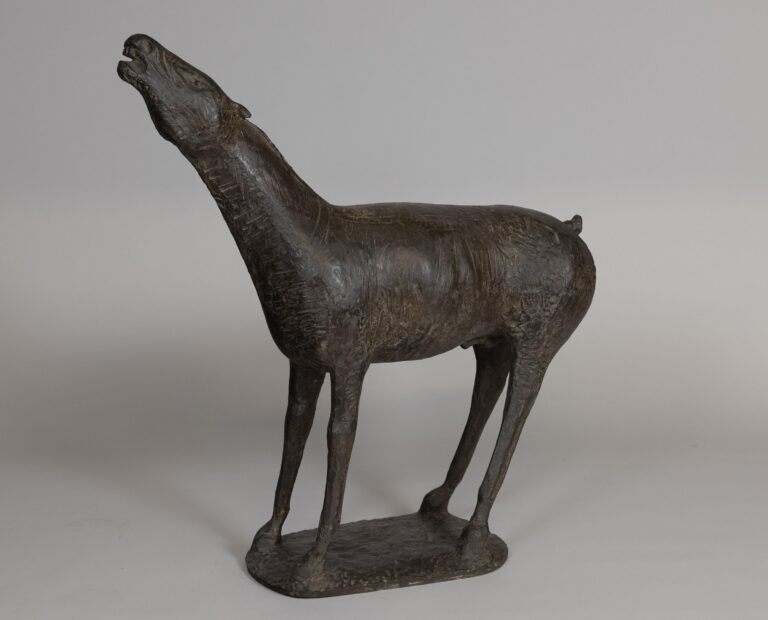
Marino Marini (1901–1980) ranks among the most significant Italian sculptors of the 20th century. Born in Pistoia, he studied at the Accademia di Belle Arti in Florence and later taught at renowned art academies, including in Milan. Early on, he intensively studied Etruscan and classical sculpture, whose archaic simplicity had a lasting influence on his work.
The artist gained international fame with his leitmotif of horseman and horse, which he explored in ever-new variations from the 1930s onwards. The initially harmonious groups gradually developed into expressive figures characterised by tension and instability – symbols of existential upheaval in an age of war and change.
In addition to sculpture, Marini created an extensive body of paintings and graphic works. His reduced, powerful formal language combines archaic rigour with modern abstraction. Today, his works are considered key examples of European modernism and are featured in major museums and private collections worldwide.
1901: Born February 27, 1901 in Pistoia, Italy.
1917: Attends the Accademia di Belle Arti in Florence.
1922: Shifts his focus from painting and encaustic to sculpture.
1928: First participation in the Venice Biennale.
1929: Appointed as a teacher at Villa Reale in Monza, near Milan.
1935: Award of Quadriennale in Rome.
1943: His studio gets destroyed during the war; relocation to Switzerland.
1954: Award of Accademia dei Lincei.
1973: Opening of Marino-Marini-Museum at the Galleria Civica d’Arte Moderna in Milan.
1980: Marino Marini dies August 6, 1980 in Viareggio.
Site managed with ARTBUTLER