La Mort d´Holopherne - André Masson
Provenienz · Provenance:
Direkt aus dem Nachlass des Künstlers erworben. · Acquired directly from the estate of the artist.

Ausstellungen · Exhibitions:
André Masson. Œuvres de 1954 à 1974, Centre Culturel Issoire, Frankreich · France, 1990; École des Beaux-Arts Nantes, Frankreich · France, 1991.
L’artiste regardé – hommage à Denise Colomb, Musée Ingres, Montauban, Frankreich · France, 1993.
André Masson nelle collezioni italiane, Palazzo dei Normanni, Sala del Duca di Montalato, Palermo, Italien · Italy, 2002.

Bibliographie · Literature:
André Masson. Œuvres de 1954 à 1974, Centre Culturel Issoire, Frankreich · France, 1990, Repr. col. N° 13.
André Masson nelle collezioni italiane, Ausstellungskatalog · exhibition catalogue Palazzo dei Normanni, Sala del Duca di Montalato, Palermo 2001, S. · P. 83.

Zertifikat · Certificate:
Die Authentizität des Gemäldes wurde durch das Comité André Masson bestätigt. ·
The authenticity is confirmed by the Comité André Masson.

Einführung · Introduction:

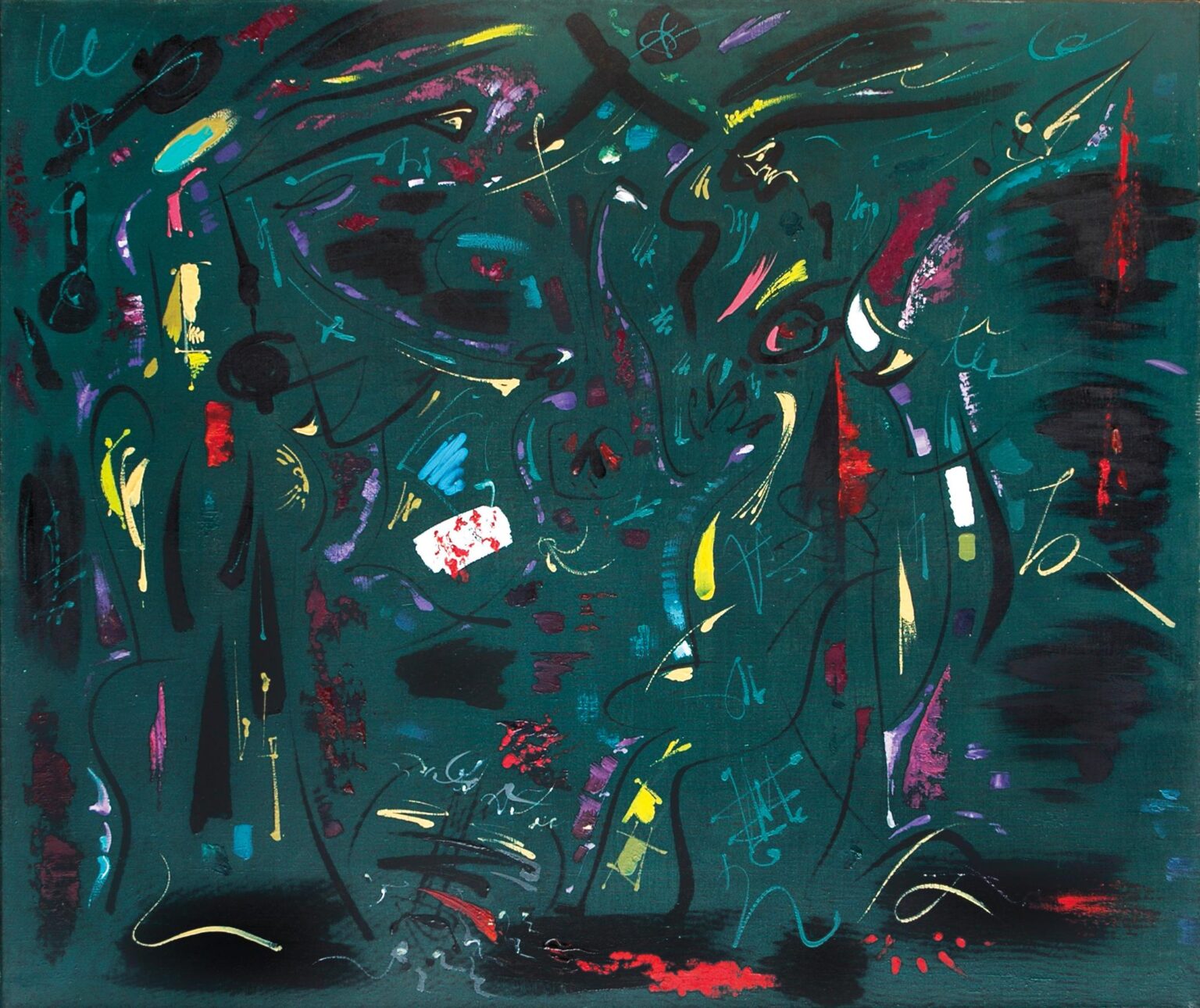
La Mort d’Holopherne, 1959

According to the Book of Judith, Holophernes, the general of Nebuchadnezzar, was instructed to seek vengeance on all of the earth and spread the glory of his king. After wreaking havoc in many countries, Holophernes was warned against attacking Jewish people. But paying no heed to this instruction, he tried to attack Bethulia by laying siege on it. But the beautiful Jewish widow Judith entered his tent whilst he was drunk and decapitated him, in order to protect her land and people.

La Mort d’Holopherne deals with the Greco-classical theme of Holophernes and Judith. Masson was always preoccupied with Greek myths and found ways to reinterpret them by adopting a uniquely novel visual language. While many classical artists like Caravaggio, Lucas Cranach the Elder, and Artemisia Gentileschi attempted to visualize this myth, what distinguishes Masson’s La Mort d’Holopherne is the uniquely modern rendition of this theme. He has chosen the moment that is most commonly represented amongst artists – that of Holophernes’s death.

But despite the abstract nature of the work, the dagger and the two figures can be discerned. Masson chooses to depict the two figures through short burst of lines. Judith, on the left hand side of the painting, holds up a dagger, while Holophernes, on the right, succumbs to his untimely death.

The work lacks the ordered structure that defined Masson’s earlier works. The background adopts the colour of the midnight, while the rest of the canvas is a frenzy of colours. The eccentric dabs of colours are dotted across the canvas in a wild and frenzied fashion. The dynamic scene unfolds within the chromaticity of the blue, reds and yellow. The red indicates the bloodshed and movement in the scene. Without being figurative, the work manages to convey the scene of a murder and the inner and external turbulence associated with it.

Newsletter-Anmeldung

Enquiry