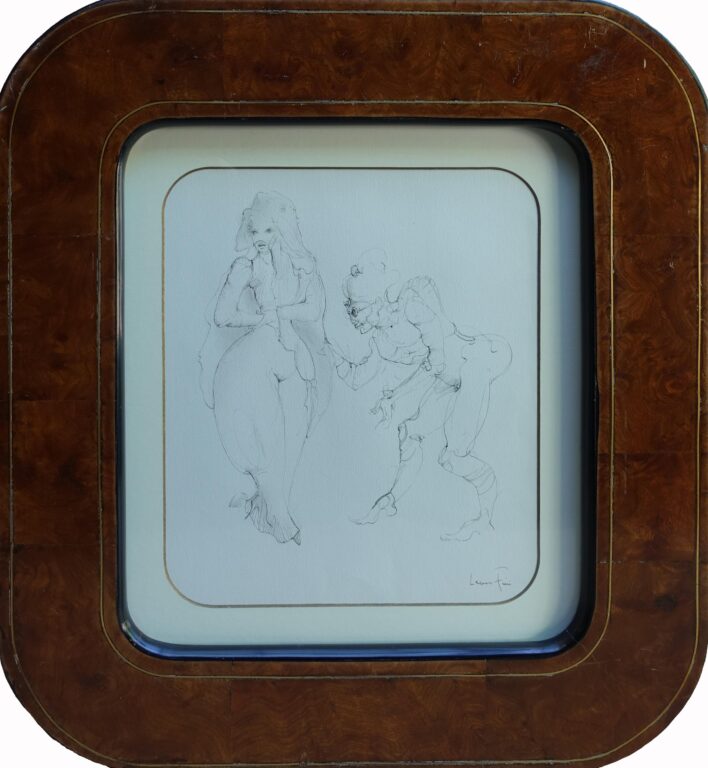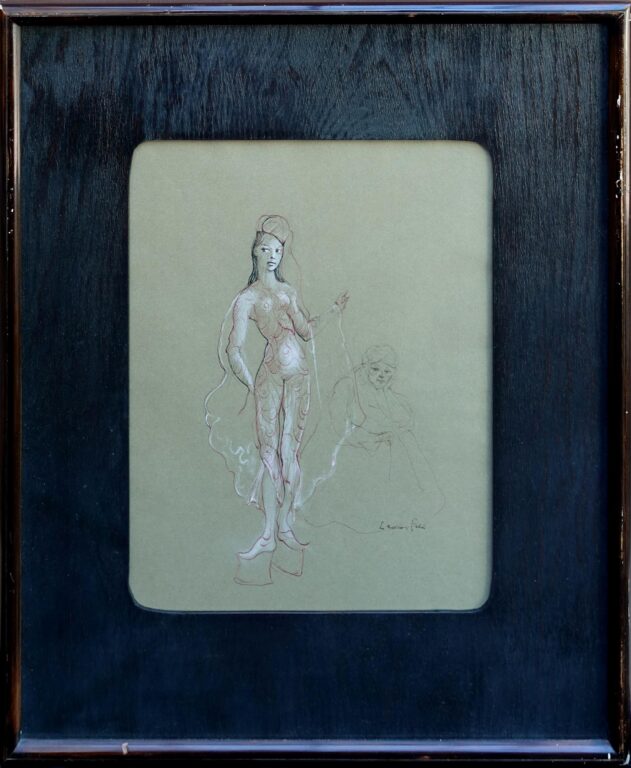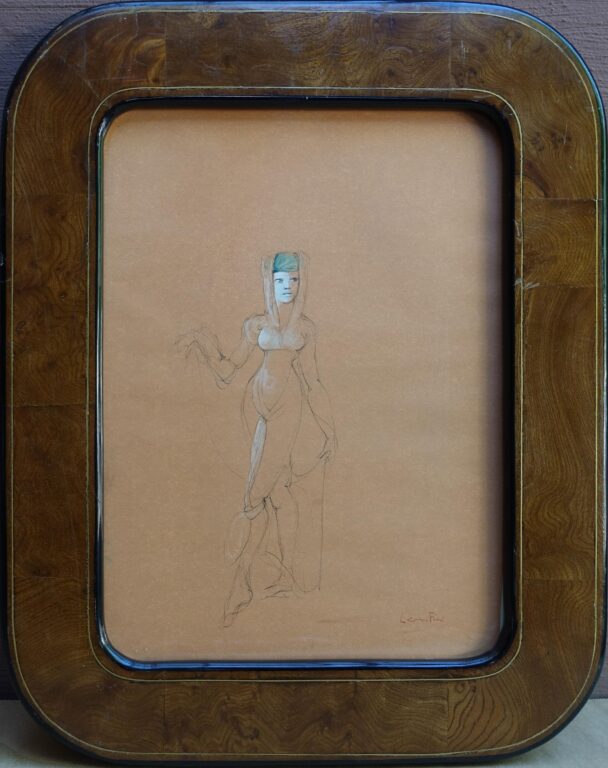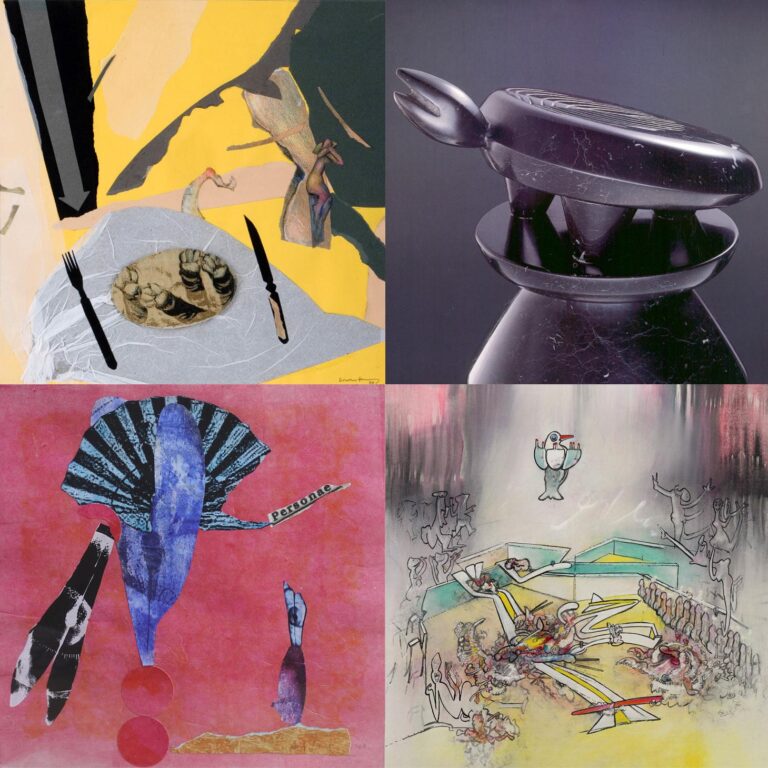
Leonor Fini was born in Buenos Aires in 1907 but grew up with her mother in Trieste. From a young age, she showed a keen interest in painting and drawing. Largely self-taught, she held her first group exhibition at just 17. In the mid-1930s, Fini moved to Paris, where her fiery personality and extravagant appearance quickly placed her at the heart of the city’s art scene. She formed close ties with leading surrealists such as Salvador Dalí, Man Ray, and Max Ernst, with whom she was romantically involved for a time. Though she exhibited with them, she never considered herself a surrealist.
Leonor Fini was an extraordinarily versatile artist; her work spans painting, graphics, book illustration, product design, and stage and costume design for theater, ballet, opera, and film. A central theme in her art is the complex relationship between the sexes, particularly the dynamic between the dominant woman and the passive man. In many of her works, the woman takes the form of a sphinx, often bearing the artist’s own features.
Alongside Leonora Carrington, Frida Kahlo, Meret Oppenheim, Remedios Varo, and Dorothea Tanning, she is regarded as one of the most significant female artists of the 20th century.
1907, born in Buenos Aires, Argentina to Italian parents.
1914: Moved with her family to Milan, Italy, after spending her early years in Argentina.
1920s: Lived between Milan and Paris, beginning her artistic career.
Self-Taught: Fini was largely self-taught as an artist, although she was influenced by classical mythology, Renaissance art, and the Symbolist movement.
1930s: Began gaining recognition for her work in Paris. Fini became involved in the Surrealist movement but never fully adhered to the group’s strict doctrines.
1936: Participated in her first group exhibition at the Galerie Pierre Colle in Paris, marking the start of her professional career in Europe.
1937: Her first solo exhibition took place at the Galleria della Cometa in Rome.
1940s: Fini’s work became known for its feminine themes, focusing on sensuality, the mythic, and the surreal. Exhibitions in Paris and New York.
1946: Worked with Jean Cocteau on designing sets and costumes for the ballet production of La Belle et la Bête (Beauty and the Beast).
1947-1948: She worked on illustrations for books, including works by Jean-Paul Sartre and Ernest Hemingway, showcasing her detailed and often fantastic imagery.
1950s-1960s: Produced a series of paintings reflecting surreal dreamscapes and mythological narratives with recurring themes of the feminine, masks, and powerful women.
1970s: During this period, Fini continued to work on large canvases, as well as costume design for theater and opera productions. She also collaborated on set designs for ballet and film.
1980s-1990s: Fini’s works were shown at major galleries, and retrospectives of her work were held in Paris and New York.
1991: A major retrospective exhibition of her works took place at the MuséeMarmottan in Paris, bringing renewed attention to her contributions to Surrealism and Symbolism.
1996: Leonor Fini passed away in Paris at the age of 88, leaving behind a legacy in the world of surreal and feminist art.
Site managed with ARTBUTLER