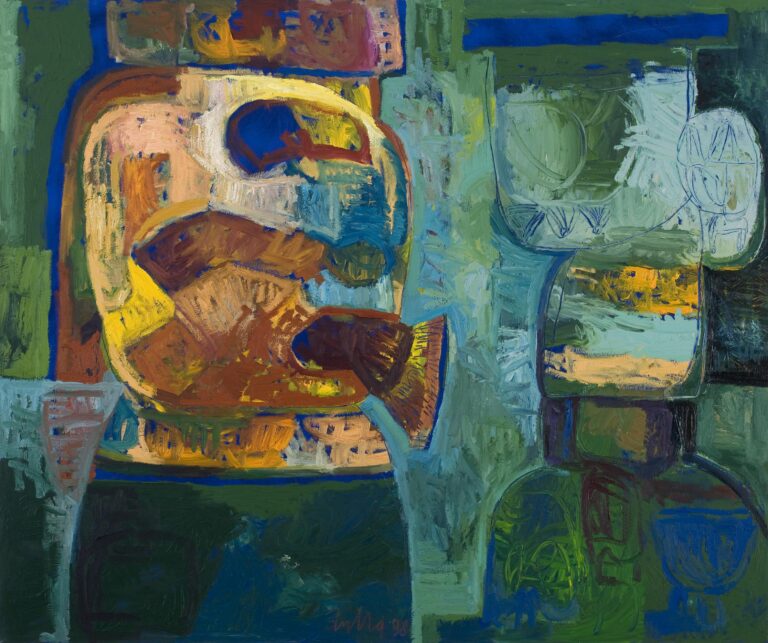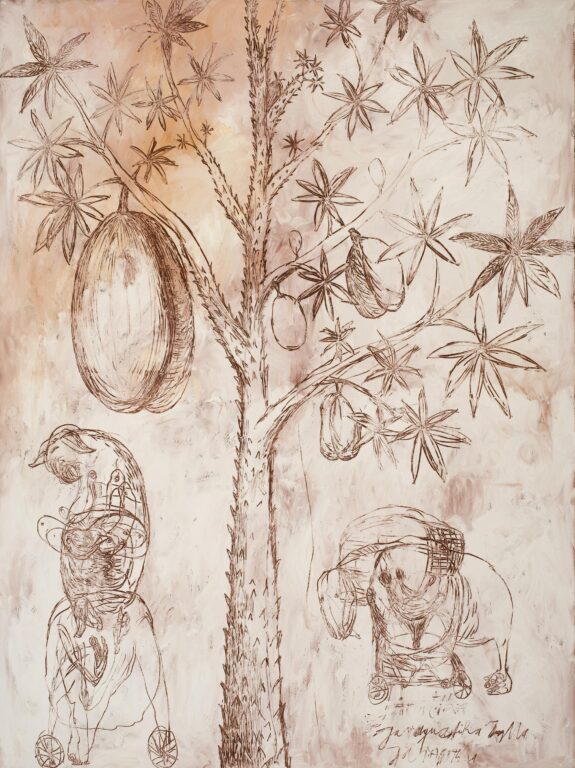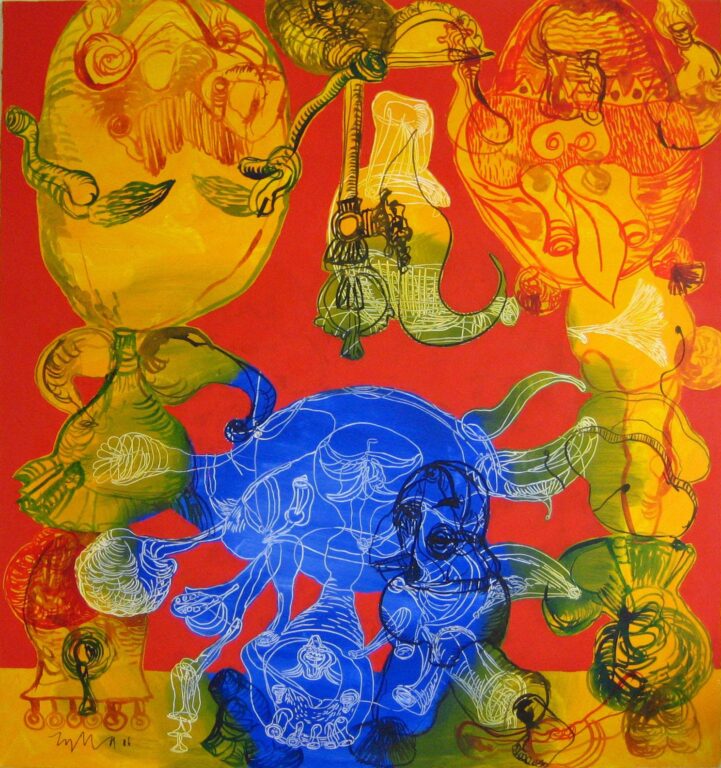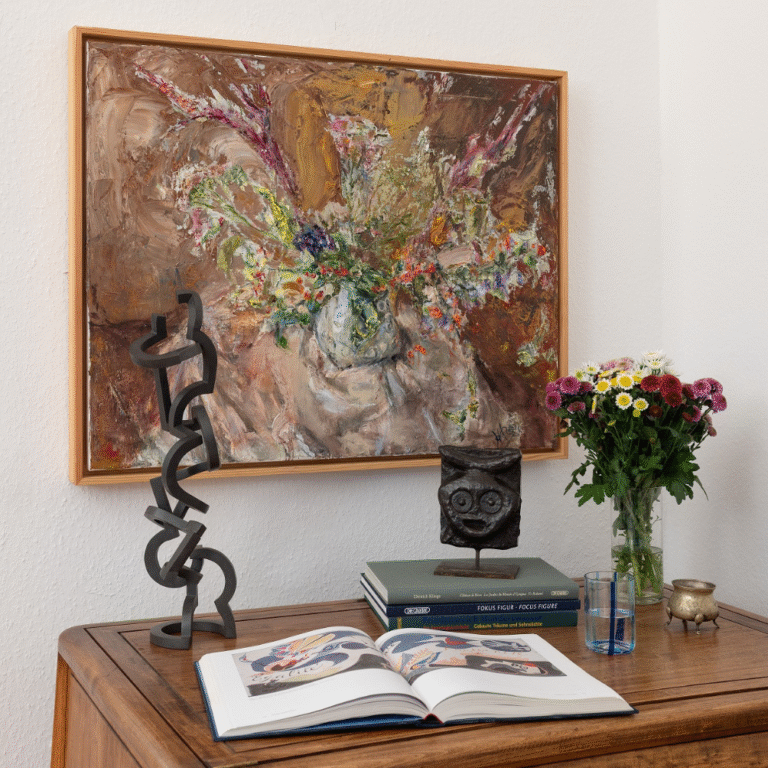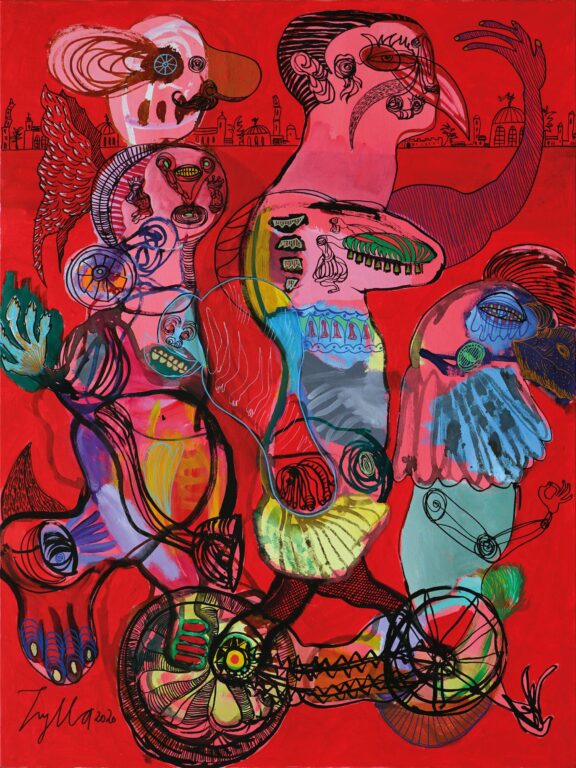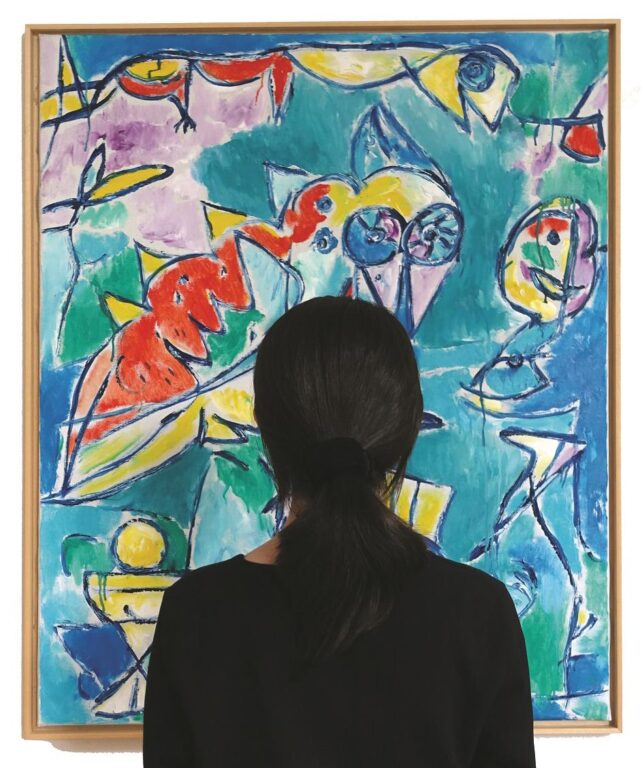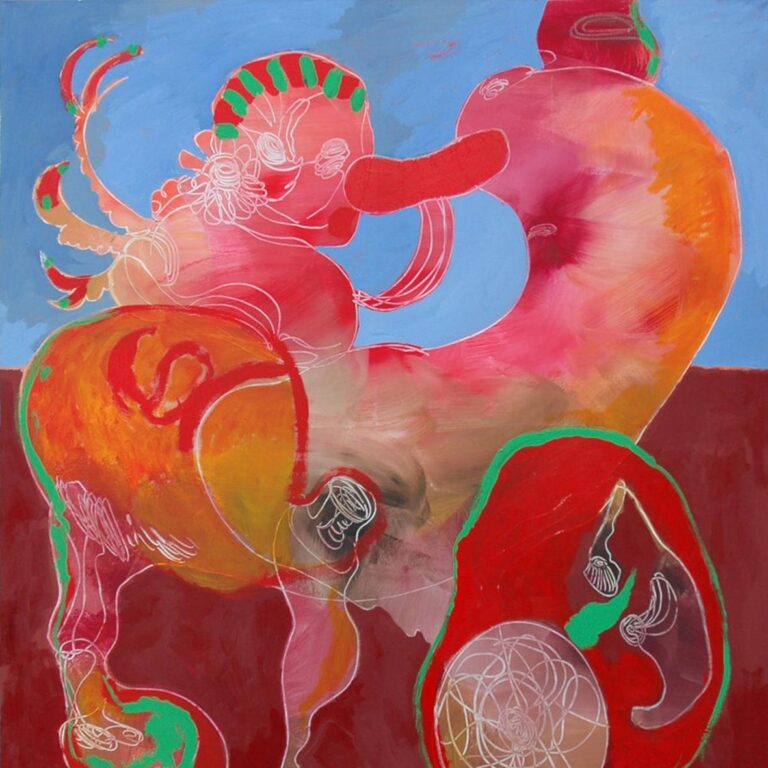
The German painter and graphic artist Klaus Zylla was born in 1953 in Cottbus, in the former GDR. His work reveals influences from Surrealism, Art Brut, and the CoBrA group. In particular, the eruptive CoBrA movement founded in 1948—with its unrestrained emotions, grotesque figures, and expressive imagery—counts among Zylla’s most important sources of inspiration, especially the Dutch painter and poet Lucebert. Through an intensive engagement with these diverse artistic approaches, Zylla developed a distinctive and turbulent visual language that oscillates between figuration and abstraction.
His paintings are often populated by surreal and grotesque creatures. Their expressions span a wide emotional range, from humor to seriousness, mockery to irony, sadness to coquettishness, and eroticism to chastity. Zylla’s technical range is equally broad: from fleeting brushstrokes to the finest, dense lines; from sharply defined areas to light, transparent layers; and from brightly luminous colors to darker tones.
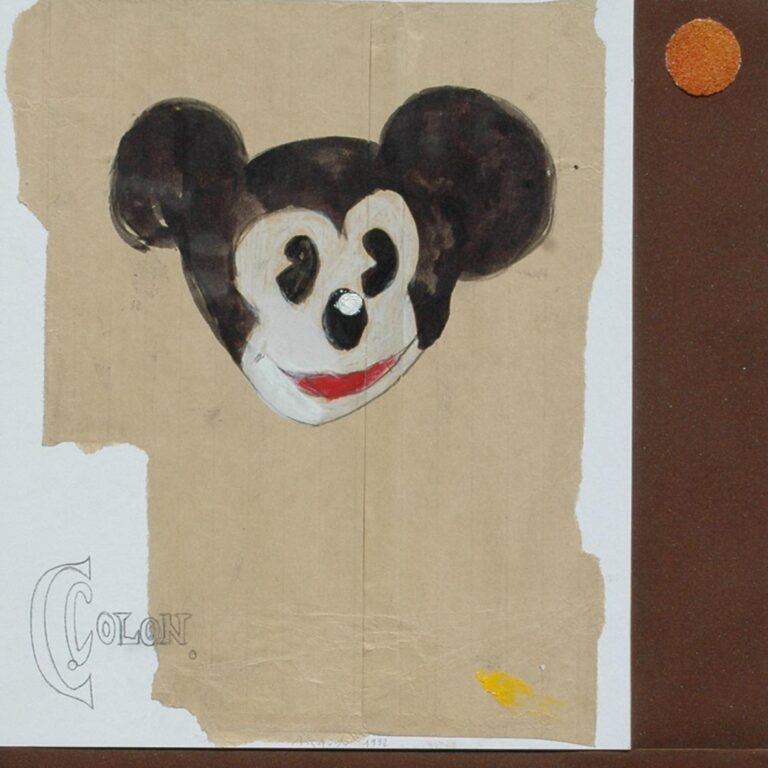
Throughout all phases of his career, Klaus Zylla has worked with literature and text, which he not only interprets thematically but also incorporates as formal elements within his compositions. The visual translation of poetry and literature has always played a central role in his work. He has illustrated texts by authors such as Antonin Artaud, Bertolt Brecht, and Thomas Bernhard; more recently, the Portuguese Nobel Prize–winning writer Fernando Pessoa has also entered his artistic universe.
Klaus Zylla lives and works in Berlin and in Portugal.
1953: Klaus Zylla is born in Cottbus, former GDR
1970: left Cottbus and became a “qualified skilled construction worker” at the Hoyerswerda housing construction company.
1974: While his mandatory military service, he was employed as an army construction engineer and worked on an atom bunker of the Warsaw Pact.
1975-77: Studied in Weimar at the Hochschule für Architektur und Bauwesen (College of Architecture and Constructional Engineering), ex-matriculated at his own request. The profession chosen for him by the state did not appeal to his predisposition. In fact his increasing turn to the arts becomes obvious.
1977-80: Moved to East-Berlin and worked as a screen printer in advertising while studying nights at the Berlin-Weißensee Art College. Created his first artistic printings. (After, into the 1990s printing was to be the defining area of experience in which he would encounter success and acknowledgement.)
1980-82: Full time studies of Industrial Design at the Berlin-Weißensee Art College. Prior to the college board’s tour in 1982, he destroyed all his studies and designs and ex-matriculated at his own request.
1982-83: Became the screen printer foreman at the Hochschule für Bildende Kunst in Dresden (Dresden University of Visual Arts). Here, Klaus Zylla´s art was initially influenced by A.R. Penck, who had already left for West Germany once and for all on 1980. Numerous graphics and the first silkscreen prints were made. Visits to the Kupferstichkabinett (Museum of Prints and Drawing) enabled him to study and analyse the art of the old masters, especially Kubin, Dürer and Hermann Glöckner.
1984: Klaus Zylla was asked to develop a silkscreen workshop for the GDR Verband Bildender Künstler (Association of Visual Artists) in Berlin. The project was delayed, but all the same he set up a workshop at the Institut für Baugebundene Kunst (Institute for Architecture and Art). Zylla drew directly on the silkscreen fabric and did small prints runs for all his pieces.
1985 : He was finally able to open his own silk-screening workshop in East Berlin, Friedrichshain. A one-man operation, it enabled him the greatest amount of freedom possible under the repressive and totalitarian GDR regime. He became one of the best and most sought-after silkscreen printers among artists in the GDR. In recognition of his achievements within the field of printing, he was admitted to the Verband Bildender Künstler as a silkscreen printer.
1986: Harry Lübke, renowned Berlin gallerist, organized the first exhibition with Zylla’s work. The East Berlin neighbourhood of Prenzlauer Berg opened a world of fruitful connections with artists, literati and intellectuals, a world that always straddled or transgressed the borders of legality. Zylla used the misprints, rejected sheets and screens of his workshop for his own artwork.
1988: After submitting an application to the Verband Bildender Künstler, Zylla travels to West Berlin; further stays in the West were to follow. The participation in a silk-screening- workshop at the West Berlin Hochschule der Künste (Berlin University of the Arts) was also approved.
1989: In September Zylla illegally smuggled some works on paper across the border to West Berlin for an illegal exhibition; news of the project leaked out in the East, but the fall of the Berlin Wall on the 9th November 1989 saved the artist from disciplinary action. The following day Zylla travelled to Amsterdam in the Netherlands, where he could finally experience the world of CoBrA art at its original source. He caught up every current of art that was forbidden under the GDR regime. The creative eruption of the early post-war CoBrA movement could well be the last inspirational station of art history that Zylla absorbed into his art, and it is from here that Zylla found his own, individual pictorial language.
1991: By this time he had already created approximately 700 works on paper. At the same time, Zylla abandoned the graphic arts and conquered the canvas.
1993: Zylla received the Art Award of the Grand Kreditbank, Berlin.
1995: Zylla made his initial visit to Portugal, the land that has since become his second home.
In 2008 and 2009 the artist Klaus Zylla who lives and works in Berlin and Reguengo Pequeno (Portugal) was dedicated a travelling exhibition through Germany, Spain, Italy, France, Sweden and Korea where a selection of his recent works was shown in different galleries and renowned museums like the Galleri Astley, Uttersberg, Sweden, the Kunstsammlung Jena and the Ludwig Museum Koblenz.
Site managed with ARTBUTLER