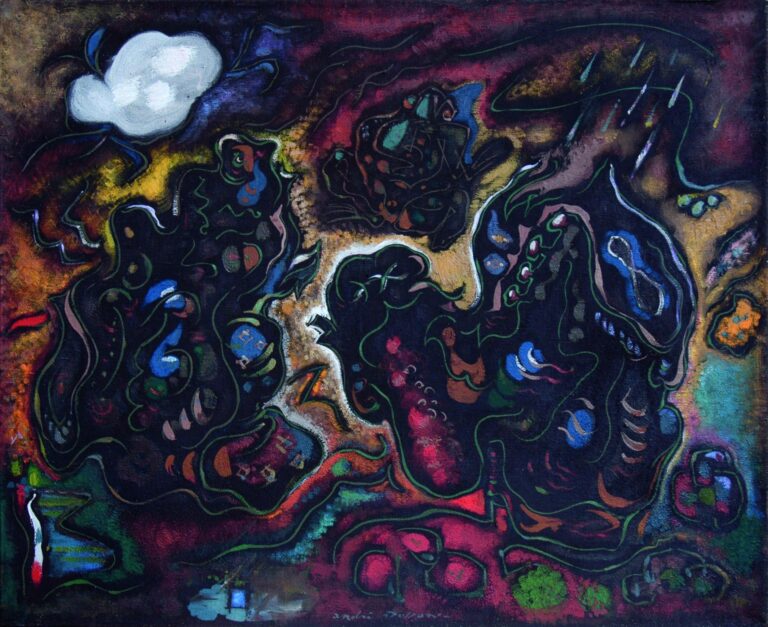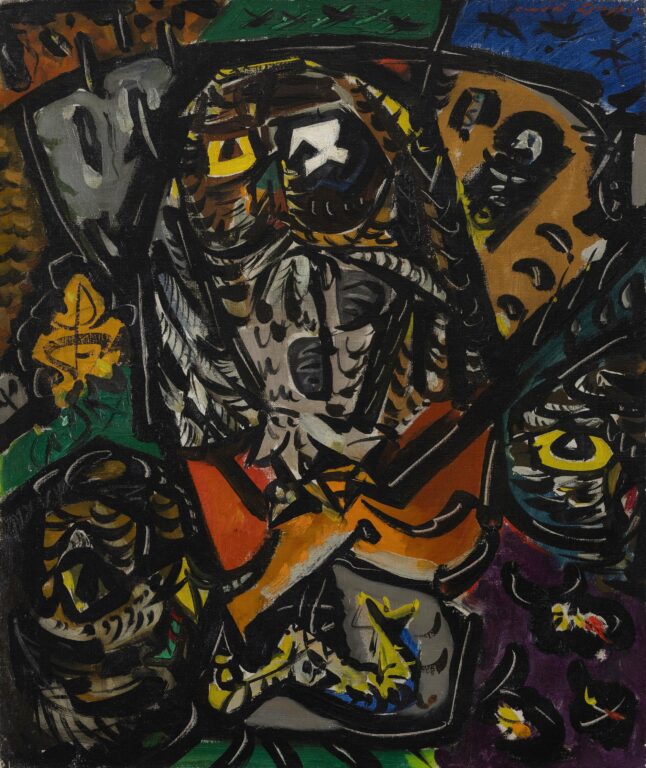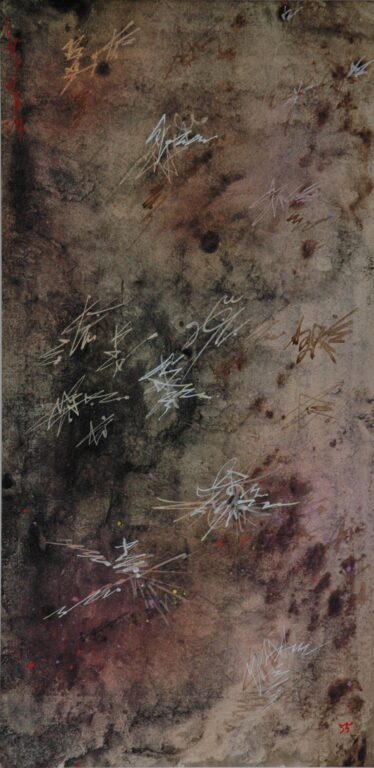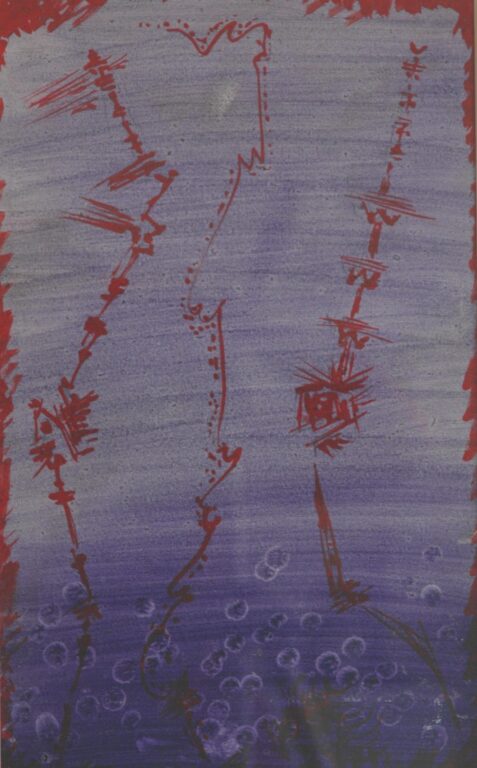
André Masson was born in Balagny-sur-Thérain in 1896. From an early age, he showed exceptional artistic talent – at just 11 years old, he was admitted to the Académie Royale des Beaux Arts in Brussels and later studied at the École Nationale Supérierure des Beaux-Arts in Paris.
After serving in the First World War, where he was severely wounded, he moved to Paris in the early 1920s. Here he developed friendships with numerous artists, poets and intellectuals of the Paris art scene, including Ernest Hemingway, Gertrude Stein, Paul Éluard and André Breton, who invited him to join the Surrealist group in 1924. In 1925, Masson took part in the first Surrealist exhibition alongside Picasso, Klee, Max Ernst and Max Ray. Towards the end of the 1920s, however, André Masson gradually distanced himself from the Surrealists and was officially expelled from the group in 1929.
After several years in the south of France, Masson went into exile in Spain in 1934. Here he found new inspiration for his painting in Spanish literature. When the Spanish Civil War began, Masson returned to France and re-established contact with the Surrealists. After the occupation of France in the Second World War, Masson was forced to flee again in 1940. He emigrated with his family to New Preston, Connecticut. In America, he met artists such as Alexander Calder, Yves Tanguy and Ashile Gorky. After his final break with André Breton in 1943, he began to explore Asian art, which led to his so-called ‘Zen period’.
In 1945, Masson moved back to Paris, and two years later he settled in Le Tholonet near Aix-en-Provence. In the 1950s and 1960s, he held numerous international exhibitions and was awarded the Grand Prix National des Arts. In 1974, he published his essay La mémoire du monde (The Memory of the World), in which he reflected on his art and his traumatic experiences during the war. He died in Paris in 1987.
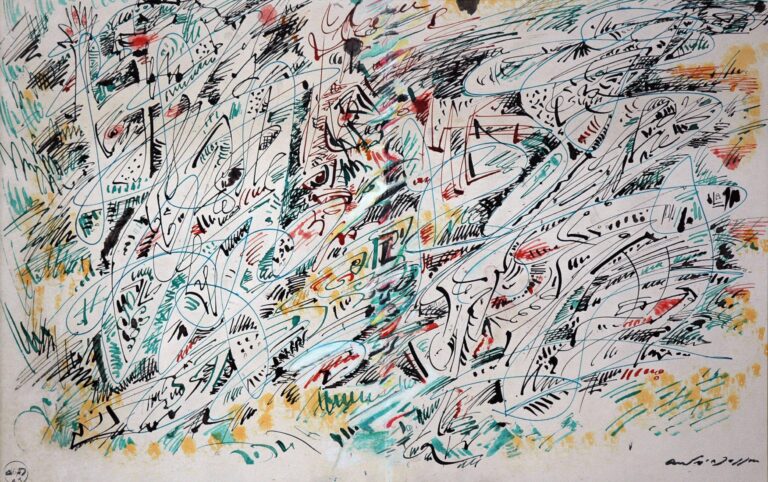
André Masson counts among the pioneers of Surrealism and is considered the inventor of ‘automatic drawing’. His vast oeuvre encompasses not only paintings, drawings and sculptures, but also stage sets and costumes, illustrated books, prints and philosophical and literary texts; his works are represented in major museums and private collections worldwide. Despite his close connection to Surrealism, he always maintained a highly individual style, which underwent constant change over the decades and is characterised by intense emotionality and a profound exploration of the depths of human consciousness.
1896: Born on January 4 in Balagny-sur-Thérain in northern France.
1907: At the age of 11 he is accepted at the Académie Royale des Beaux-Arts et l ´Ecole des Arts Décoratifs, the Belgium national art school in Brussels. His main instructor is the Symbolist Constant Montald. The work of James Ensor introduces him to modern painting.
1912-1913: Moves to Paris and studies under Raphael Collin and Paul Baudoin at the Ecole Nationale Supérieure des Beaux-Arts.
1914: Studies fresco painting in Tuscany, has an extended visit to Switzerland. When World War One breaks out, he returns to Paris and volunteers for war.
1917: A severe chest injury forces repeated stays in hospital. He is detained due to anti-militaristic activities.
1918/19: Joins Maurice Loutreuil in Martigues and begins to paint landscapes.
1921: Moves into an atelier on the Rue Blomet, near that of Joan Miró. The art dealer Daniel-Henry Kahnweiler takes his work under contract.
1922: Meets Jean Dubuffet, Georges Limbour and André Malraux. Intensive engagement with erotic drawings and gouaches.
1923: Experiments with automatic drawing, or écriture-automatique. Has contact to Antonin Artaud, Gertrude Stein and Louis Aragon.
1924: First solo exhibition at the Galerie Simon in Paris. André Breton invites him to become a member of the Surrealists. Meets Ernest Hemingway.
1925 : Meets Yves Tanguy, Jacques Prévert, Jacques Doucet and Pablo Picasso.
1926: Creates his first paintings using glue and sand. The pictorial topic of his work increasingly involves violence and death.
1927: Meets Alberto Giacometti, who motivates his first attempts at sculpture.
1930: He is introduced to Zen Buddhism and Asian art, which become important sources of inspiration for his art, by the Japanese Kuni Matsuo.
1932: Meets Henri Matisse in southern France.
1933: Designs the stage sets and costumes for Léonide Massine´s ballet Les Présages. The first issue of the magazine Minotaure, with which Masson is heavily involved, is published.
1936/37: He draws the cover of the premier issue of the magazine Acéphale. When the Spanish Civil War breaks out, he returns to France. Renews contact to the Surrealists.
1939: Creates imaginary portraits and city scenes as well as sand paintings and objects made from found bits and pieces. After the outbreak of WWII, he begins to emphasise the metaphysical meaning of his work.
1941: Escapes to the United States, to New Preston, CO. Befriends Alexander Calder, Arshile Gorky, and Yves Tanguy (among others). His work influences the young painters of Abstract Expressionism, particularly Jackson Pollock.
1943: Breaks up with André Breton.
1945-47: Meets Jean-Paul Sartre. Returns to Paris.
1954: Is awarded the Grand Prix National des Arts, the national art prize of France.
1964: Decreasing abstraction in his work.
1976: Due to physical infirmity, Masson must rely on a wheelchair; he stops painting at the end of the 1970s.
1987 : Dies in Paris on the night of 27 October.
Site managed with ARTBUTLER