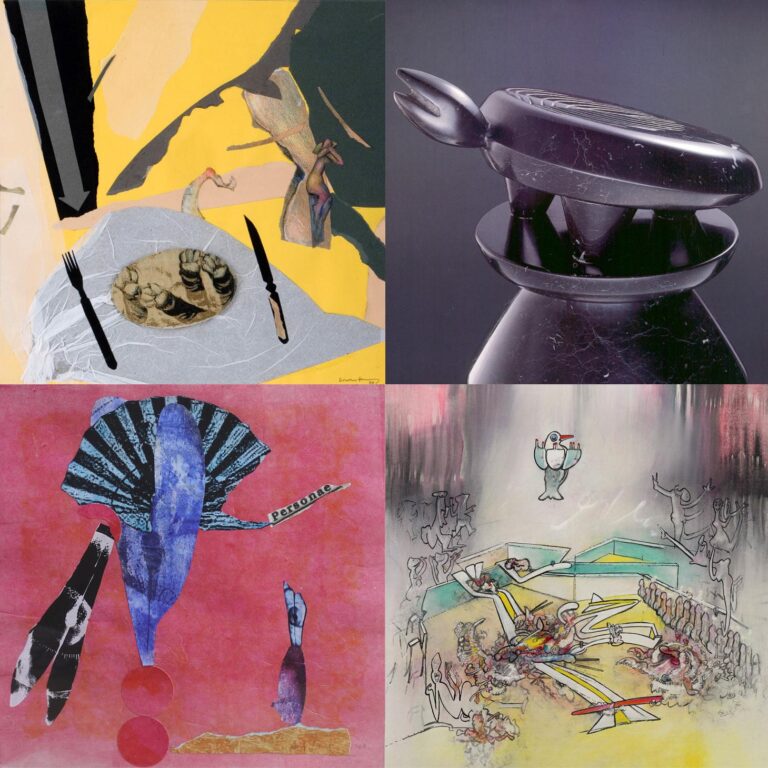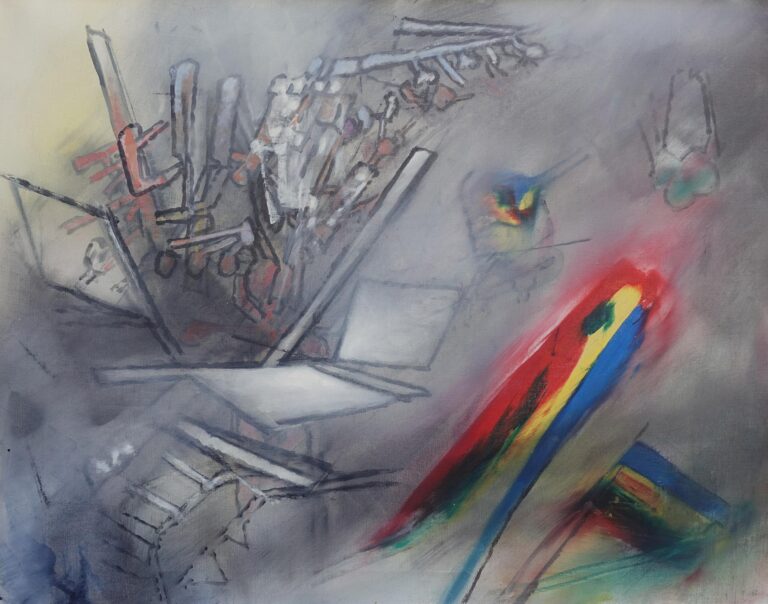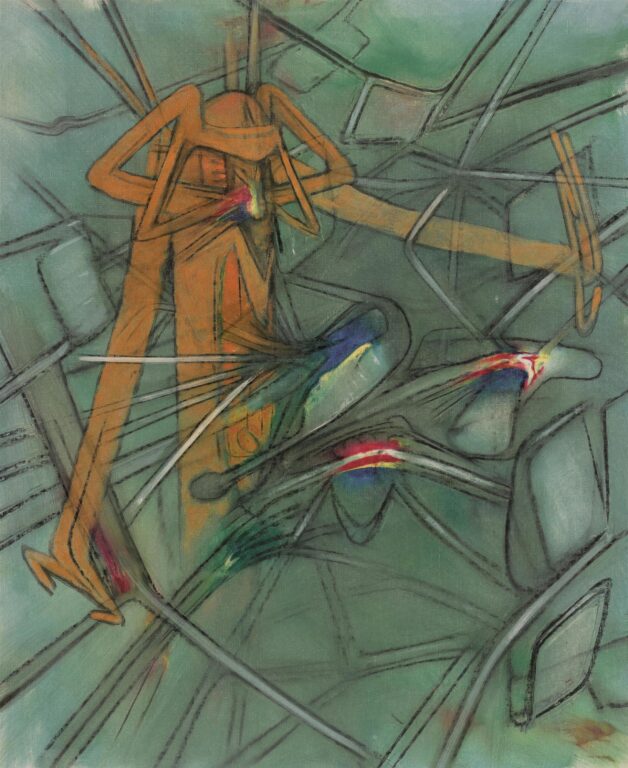
Roberto Matta was a renowned Chilean surrealist painter and architect, celebrated for his vibrant, imaginative works that explored the unconscious mind and the relationship between space, time, and human existence. Initially trained as an architect, Matta’s unique approach to painting merged elements of abstract expressionism with surrealism, creating dreamlike landscapes filled with bold colors and fluid, organic forms. His works often depict intricate, otherworldly environments, drawing inspiration from both psychological theory and the chaos of the modern world. Matta was a key figure in the international art scene and a pioneer of Latin American modernism, leaving a lasting influence on both contemporary art and the surrealist movement.
1911: Roberto Matta (Roberto Antonio Sebastián Matta Echaurren) is born on November 11th in Santiago de Chile.
1932: He completes his studies in architecture at the Universidad Católica in Santiago de Chile with a diploma in the utopian architectural project League of Religions.
1933: Matta goes to Paris and works until 1936 in Le Corbusier’s architectural office.
1935-1939: Begins to make drawings and during numerous trips makes the acquaintance with other artists such as Salvador Dalí, René Magritte, László Moholy-Nagy, Henry Moore, Roland Penrose, numerous architects, including Alvar Aalto, Walter Gropius and writers such as Rafael Alberti, André Breton, Federico Garcia Lorca, Pablo Neruda.
1937 : The artist is officially appointed as a surrealist by André Breton. From 1938: Matta begins to paint and participates in the large exhibition Exposition Internationale du Surréalisme in Paris.
1939: Travels to New York and is in close exchange with the art scene around Arshile Gorky, William Baziotes, Robert Motherwell, Frederick Kiesler, Jackson Pollock, and others.
1940: Already six months after his arrival in America, Matta has his first solo exhibition in the gallery Julien Levy.
1942: He participates in the exhibition Artists in Exile, among others with André Breton, Marc Chagall, Max Ernst, Fernand Léger, André Masson, Piet Mondrian and Yves Tanguy. After his solo exhibition The Earth is a Man, further exhibitions follow.
1945: Matta is in close contact with Marcel Duchamp.
1946: Numerous trips to Europe influence his work, in which he deals with the terror of fascism.
1948:Temporary exclusion from the group of surrealists. Matta is in Chile, where he writes the text Reorganización de la Afectividad, which addresses the role of the artist as a “revolutionary” of society.
As of 1950: Works among others in a studio community with Fabius von Gogel.
As of 1957: After a first major retrospective at the Museum of Modern Art in New York and a retrospective at the Moderna Museet in Stockholm, Matta has a number of other solo exhibitions, 1963 in Dusseldorf, 1964 in Brussels and exhibitions in 1959 at the Documenta II in Kassel, and in 1964 at the Documenta III.
1963: The artist receives the Marzotto Prize.
1968: He is increasingly engaged with politics, which is reflected in his exhibition themes.
1970: Retrospective in the Nationalgalerie in Berlin.
1974: At the Venice Biennale, running under the motto “For a Democratic and Anti-Fascist Culture,” Matta shows works he has created for the Brigada Ramona Parra.
1974: Roberto Matta has an extensive exhibition in the Kestnergesellschaft in Hannover.
1977 : The worldwide interest in Matta becomes increasingly evident: he attends documenta 6, receives the honorary doctorate from the Royal College of Arts in London, and in 1985 his multi-faceted oeuvre is exhibited in the Musée National d’Art Moderne Center Georges Pompidou in Paris.
From 1990 onwards Matta receives several awards, including the 1992 Premio Príncipe de Asturias and 1995 Japanese Praemium Imperiale.
2002: Roberto Matta dies on November 23 in Civitavecchia.
Site managed with ARTBUTLER