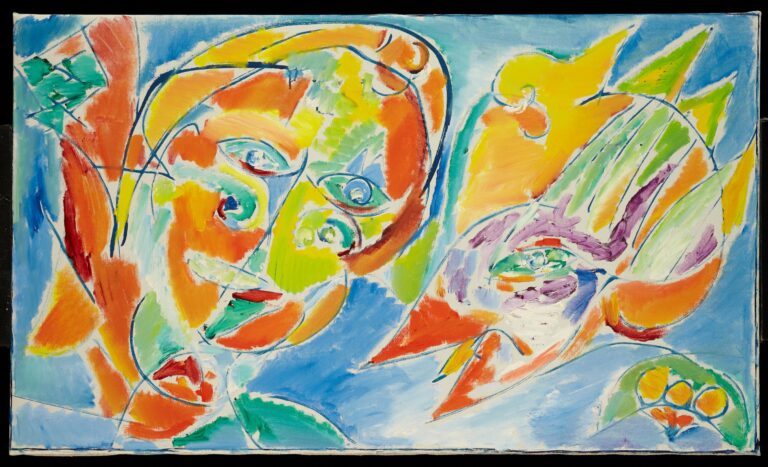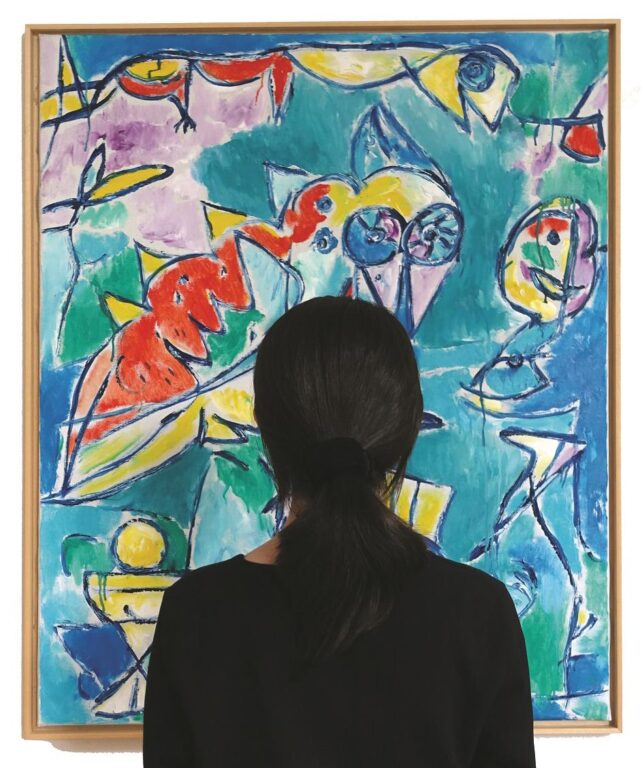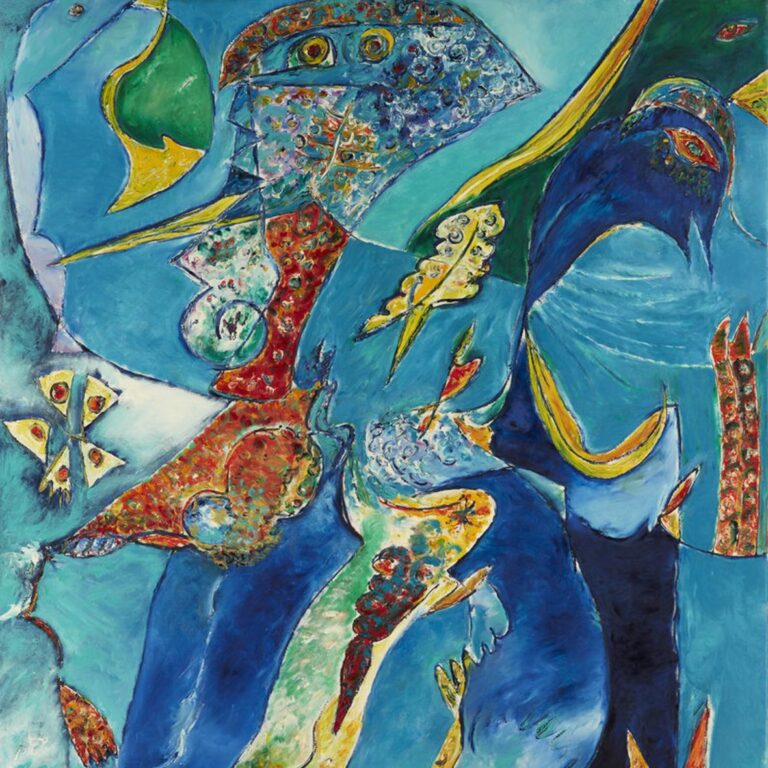
Carl-Henning Pedersen, born in Copenhagen in 1913, is considered one of the most important masters of the CoBrA group. Owing to the intense coloration of his works — particularly the strong presence of blue tones—he is often referred to as the “Chagall of the North.”
Pedersen was largely self-taught and began painting under the influence of his first wife, Else Alfelt, who was also an artist. Both later became members of CoBrA. Carl-Henning Pedersen’s art oscillates between figuration and abstraction. His canvases are populated by surreal figures, mythical creatures, and animals — especially birds — and are frequently inspired by motifs drawn from Nordic and Greek mythology.
1913: Born in Copenhagen, Denmark.
1933: Meets the painter Else Alfelt at the International Folk High School in Elsinore and marries her in 1934. Inspired by her he starts to paint remaining completely self-taught throughout his life. Gets in contact with the Danish avant-garde.
1936: Joins the Artists’ Autumn Exhibition in Copenhagen with four abstract paintings.
1939: First trips to France and Germany where he gets involved with modern art;visits the exhibition Entartete Kunst.
1941-45: Writer and co-editor of the art review Helhesten together with Else Alfelt, Ejler Bille, Henry Heerup, Egill Jacobsen, Robert Jacobsen and Asger Jorn.
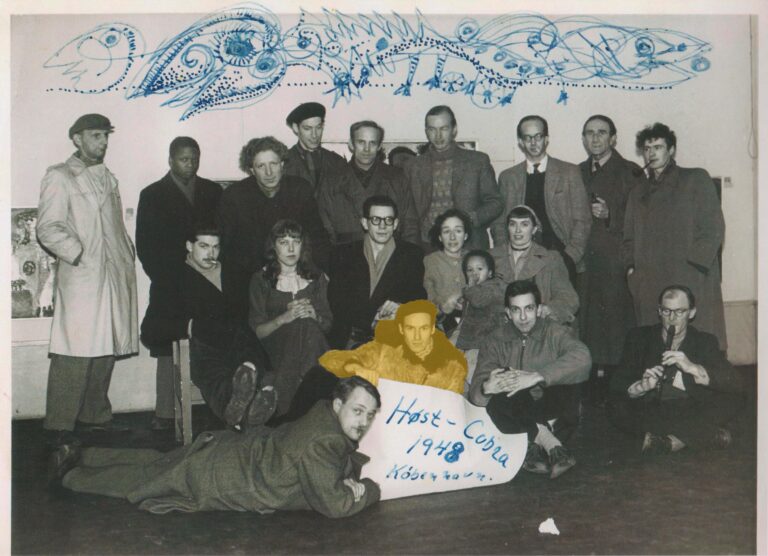
1942-49:Member of the artist group Høst, together with Karel Appel, Corneille and Asger Jorn.
1948-51: Member of the CoBrA group; participates at the first exhibition of the group at the Stedeijk Museum Amsterdam and at the last one at the Palais des Beaux-Art in Liège, Belgium; participates at the Venice Biennale.
1958: Receives the international Guggenheim award for Denmark; builds an atelier in Bovbjerg, Denmark.
1962: Participation at the Venice Biennale and at Sao Paolo Biennale; receives UNESCO Prize.
1964:Completes the mosaic wall The Cosmic Ocean for the H. C. Ørsted Institute of the Copenhagen University.
1966-68: Creates a 5 x 200 m long ceramic mural for the Angli factory, today part of the Herning Art Museum.
1970: Stage design for the opera Wozzeck by Alban Berg; represents Denmark at the Expo in Osaka, Japan.
1974: Death of his wife Else Alfelt.
1975: Follows the invitation to the artist colony Michkenot Sha’ananim, Jerusalem, where he meets his second wife, the photographer Sidsel Ramson; the couple settles in Barbizon near Paris.
1975-76: Creates a ceramic mural consisting of 1000 tiles for the Carl-Henning Pedersen and Else Alfelt Museum in Herning, Denmark, to which he donates the major part of his and Else Alfelt’s work; the museum is inaugurated in 1976.
1977: Moves to Burgundy.
1980: Receives the Prince Eugen Medal.
1983: Unveiling of the painted glass window The Light of Liberty for the Museum of the Danish Resistance, Copenhagen; starts the decoration of the Ribe cathedral, Denmark.
1998: Commission to paint four large size paintings for the Hall of Mirrors at the Prime Minister’s Department, Christiansborg, Copenhagen.
2007: Dies in Frederiksberg, Denmark.
Site managed with ARTBUTLER