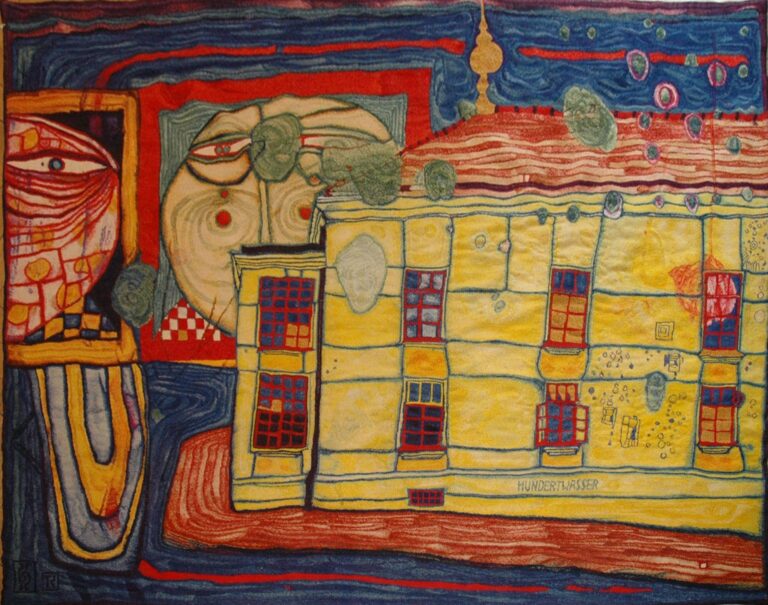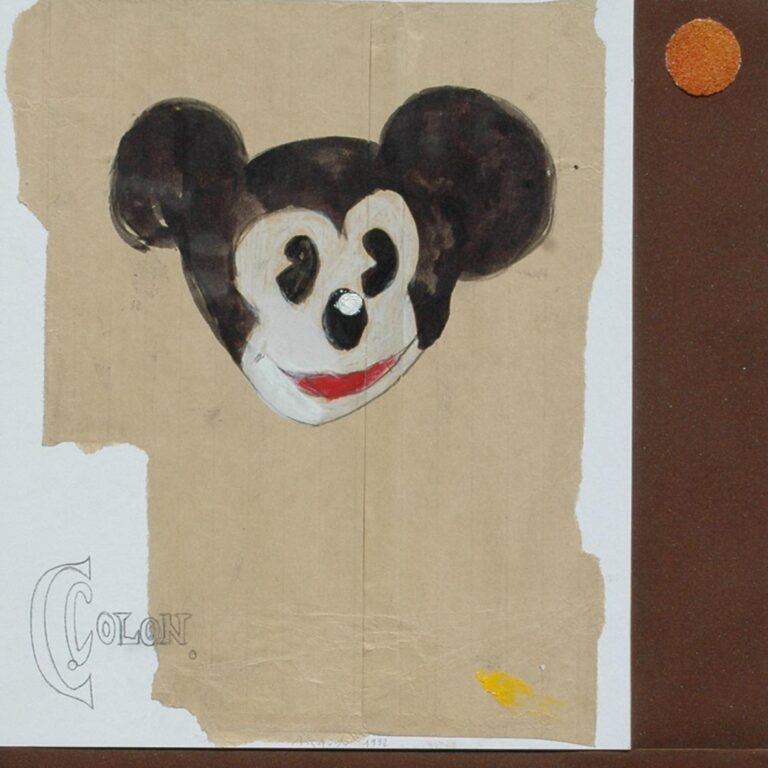
Born in Vienna in 1928, artist Friedensreich Hundertwasser (born Friedrich Stowasser) ranks among the most renowned personalities of post-war modernism.
As an important member of the international avant-garde in Paris in the 1950s, he developed his distinctive visual language. His extensive graphic work contributed significantly to his popularity. Within a single edition, he deliberately created variations in colour and form, ensuring that each sheet is virtually unique.
In addition to his art, Hundertwasser was strongly committed to ecological issues and environmentally friendly architecture. His buildings with green roofs, uneven floors and ‘tree tenants’ epitomise diversity, organic forms and a life in harmony with nature. He also used manifestos, letters, speeches and public actions to address environmental destruction, profit-driven thinking and social conformism.
1928: Born as Fritz Stowasser in Vienna on 15 December.
1943: Creates first colour-pencil drawings of nature. Sixty-nine Jewish family members on his mother’s side are deported and killed.
1948–1949: Attends the Academy of Fine Arts in Vienna under Prof. Robin Christian Andersen for three months. He begins to sign his works with his nom d´artiste Hundertwasser (sto means one hundred in Russian and Wasser means water in German).
1949–1951: Extensive study trips with the French writer René Brô to Paris, Tunisia, Morocco, Spain and Sicily.
1950: In Paris, he paints two wall murals in the district of Sainte Mandé with René Brô. Hundertwasser leaves the Ecole des Beaux Arts, the school of fine arts, on his first day there.
1952–1953: First exhibition at the Art Club of Vienna.
1954: First exhibition in Paul Facchetti’s studio in Paris. Develops the theory of Transautomatism and begins to number his works.
1958: Reads his Mould Manifesto against rationalism in architecture during a congress at Seckau Abbey, Austria.
1959: Receives the Sanbra Prize at the Sao Paolo Biennale. With Ernst Fuchs and Arnulf Rainer, he co-founds the Pintorarium, a universal academy for all creative arts.
1960: Visits Japan, during this time the name Friedensreich is created. He translates his first names into Japanese writing characters, which also mean peace and realm, and from then on calls himself Friedensreich (Realm of Peace). Receives the Mainichi Award at the 6th International Art Exhibition in Tokyo.
1961: Retrospective at the Venice Biennale.
1968: Gives his second nude speech and reads the architecture-boycott manifesto Loose from Loos in Vienna. Sails from Sicily to Venice in the San Giuseppe T, an old wooden sailing ship.
1973: First portfolio of Japanese woodcuts, entitled Nana Hiaku Mizu.
1974: Designs postage stamps. The Albertina exhibition, featuring his entire graphic oeuvre, tours the USA: New York, Boston.
1975: Travelling exhibition tours the world: Tel Aviv, Warsaw, Reykjavik, Copenhagen and Dakar. The Albertina exhibition of graphics goes to Brooklyn, Maryland (USA). Produces his second portfolio of Japanese woodcuts, Midori No Namida.
1978: Designs the Peace Flag for the Near East. Publishes his Peace Manifesto. The travelling exhibition tours Mexico City, Montreal, Toronto, Brussels and Budapest. The Albertina exhibition goes to Canada, Germany and Morocco.
1980: Washington D.C. declares 18th November as Hundertwasser Day. Trees are planted on Judiciary Square, the anti-nuclear poster Plant Trees Avert Nuclear Peril and the environmental poster Arche Noah 2000 for Germany are presented. Receives the Grand Austrian State Prize.
1981: Awarding of the Grand Austrian State Prize in 1980 and speech against nuclear power and on false art. Awarded the Austrian nature conservation prize. Appointed head of the master school of painting at the Academy of Fine Arts Vienna.
1985: Completion of the Hundertwasser House.
1990: Works on architectural projects: KunstHausWien; Motorway Restaurant, Bad Fischau; AGIP Service Station, Vienna; the district heating plant of Spittelau; the shopping centre Village, Vienna; the textiles factory Muntlix, Rogner-Bad Blumau; and the redesign of the Martin Luther Gymnasium, a school in Wittenberg.
1992: Participates in the Documenta 9 in Kassel.
1994: Campaigns against Vienna´s entry into the European Union.
1995: Publication of the limited edition Hundertwasser Bible.
1998: Museum retrospective at the Institut Mathildenhöhe in Darmstadt.
1999: Lives and paints in New Zealand. Works on architectural projects: Sludge Centre in Osaka, Japan; Green Citadel in Magdeburg; and the Uelzen Railroad Station. Assists in the reconstruction of the Kawakawa Public Toilet, New Zealand.
2000: Friedensreich Hundertwasser dies of heart failure on 19 February aboard the Queen Elizabeth II during a return trip from New Zealand. He is buried on his property in New Zealand, nude and wrapped in a flag, under a tulip tree.
Site managed with ARTBUTLER